
Global bond markets have been climbing, and Canada has seen bond yields increase as well.
That matters for mortgage borrowers, especially after a year when many people chose variable-rate mortgages because they offered lower rates than fixed options.
But variable rates come with a trade-off: you accept more uncertainty in exchange for the potential benefit of a lower rate.
Now, with some economists expecting potential rate increases, many variable-rate mortgage holders may be wondering whether it's time to lock into a fixed rate.
Before making that decision, there are a few things worth considering.
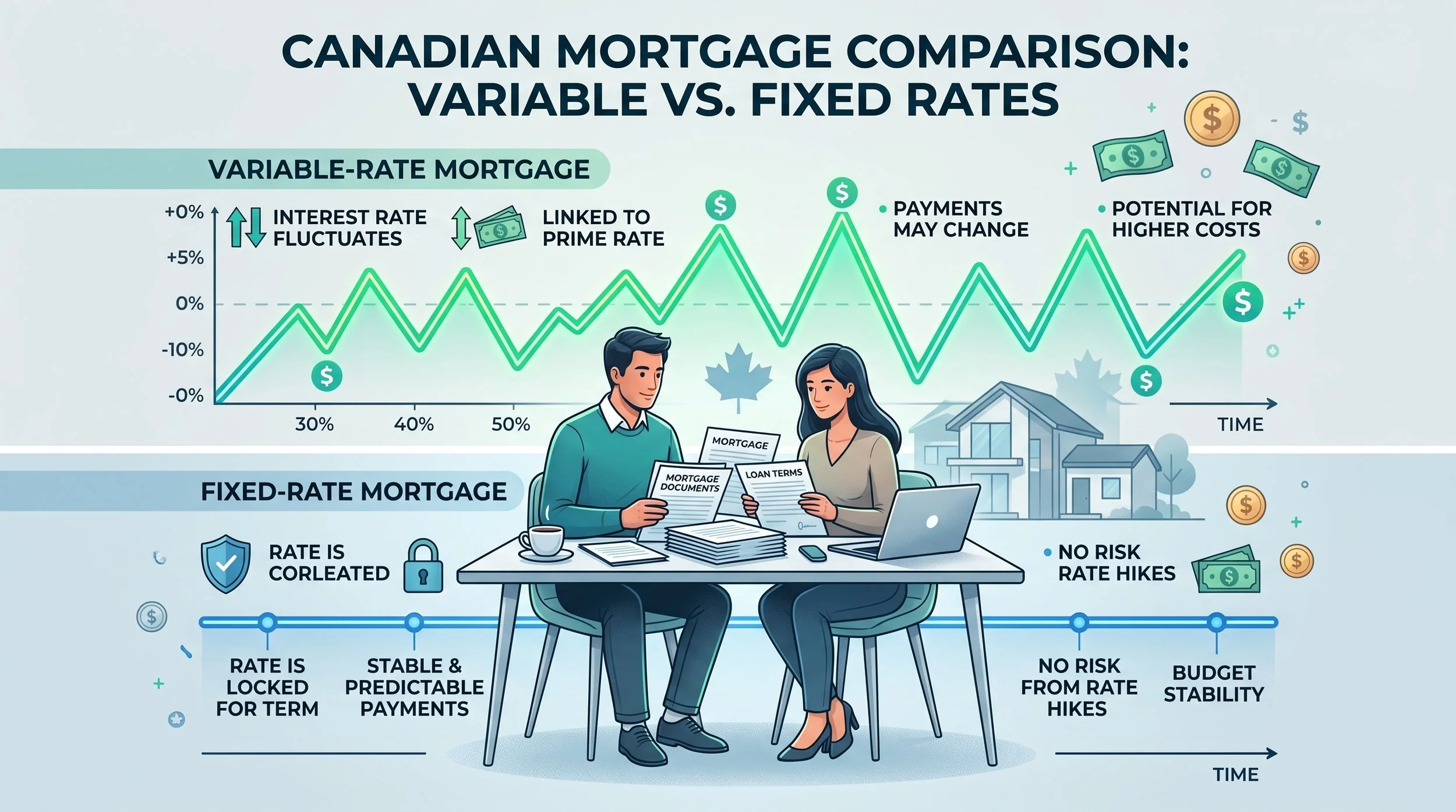
Variable Rates Come With Risk
Choosing a variable mortgage means accepting that your rate can change.
Sometimes that works in your favour. Sometimes it doesn't.
Even when fixed rates were lower than variable rates, those lower rates were based partly on expectations about where interest rates were heading.
The important thing is to look at what you've actually paid, rather than only looking at where rates are today.
Many variable-rate borrowers have paid a lower rate for months, depending on when they started their mortgage. Fixed-rate borrowers, meanwhile, paid a premium for the certainty of knowing their rate wouldn't change.
Now, that certainty may feel more valuable.
But that doesn't automatically mean everyone with a variable mortgage should switch.
5 Things to Consider Before Locking Into a Fixed Rate
1. Remember That Forecasts Aren't Guarantees
Economists don't always agree on what the Bank of Canada will do next.
A forecast is just that — a forecast.
Rates could increase, but we don't know exactly how high they'll go, how long they'll stay there, or whether they'll eventually come back down.
Instead of making a long-term mortgage decision based solely on someone else's prediction, look at how different rate scenarios would affect your own finances.
2. Understand How Your Variable Mortgage Actually Works
This is an important one.
If rates increase, what happens to your mortgage?
Will your payment increase?
Or will more of your existing payment go toward interest while less goes toward principal?
The answer depends on your specific mortgage.
If you're not sure, check with your mortgage broker and understand exactly how your mortgage responds to rate changes. This can make a big difference when deciding whether staying variable still makes sense for you.
3. Stress-Test Your Own Budget
Instead of worrying about headlines, look at your own numbers.
For example, on a $1 million mortgage, two 0.25% increases would represent roughly $5,000 more per year in interest, or about $416 per month, assuming the full increase flows through to interest costs.
The question is:
Could your budget comfortably absorb that increase?
If the answer is yes, you may have more flexibility than you think.
If the answer is no, it may be worth looking more seriously at your fixed-rate options.
4. Find Out What Fixed Rate You Can Actually Get Today
Don't compare your current variable rate to a hypothetical fixed rate.
Find out what fixed rate is actually available to you right now.
Then you can compare your real options:
Your current variable rate
The fixed rate available to you
How your payment could change
How much certainty the fixed rate provides
What you might be giving up by locking in
That's a much more useful comparison than simply reacting to a rate forecast.
5. Consider What You Can Comfortably Live With
If a higher mortgage payment would put significant pressure on your budget, the certainty of a fixed rate may be worth paying for — depending on the fixed rate available to you.
On the other hand, if you have room in your budget, you may decide to stay variable and voluntarily increase your payments.
You'd be paying more, but that additional payment could help reduce your principal while you wait to see where rates actually go.
So, Should You Switch From Variable to Fixed?
There isn't one answer that works for everyone.
If you're comfortable with your current payment and have room in your budget for potential increases, you may decide to stay variable.
If a higher payment would seriously strain your finances, having the certainty of a fixed payment could be more valuable.
The key is to look at your mortgage and your budget before making the decision.
The Bottom Line
There’s no one-size-fits-all answer when it comes to choosing between a variable and fixed mortgage.
Instead of reacting to rate predictions, take a look at your own mortgage, your budget, and the options available to you today.
Understand how your variable rate responds to increases, see what fixed rate you could get, and compare the numbers before making a decision.
The goal isn't to predict exactly where rates are going. It's to make sure you're comfortable with your mortgage regardless of where they go next.
