
MMM : From Geopolitics to Your Mortgage Rate
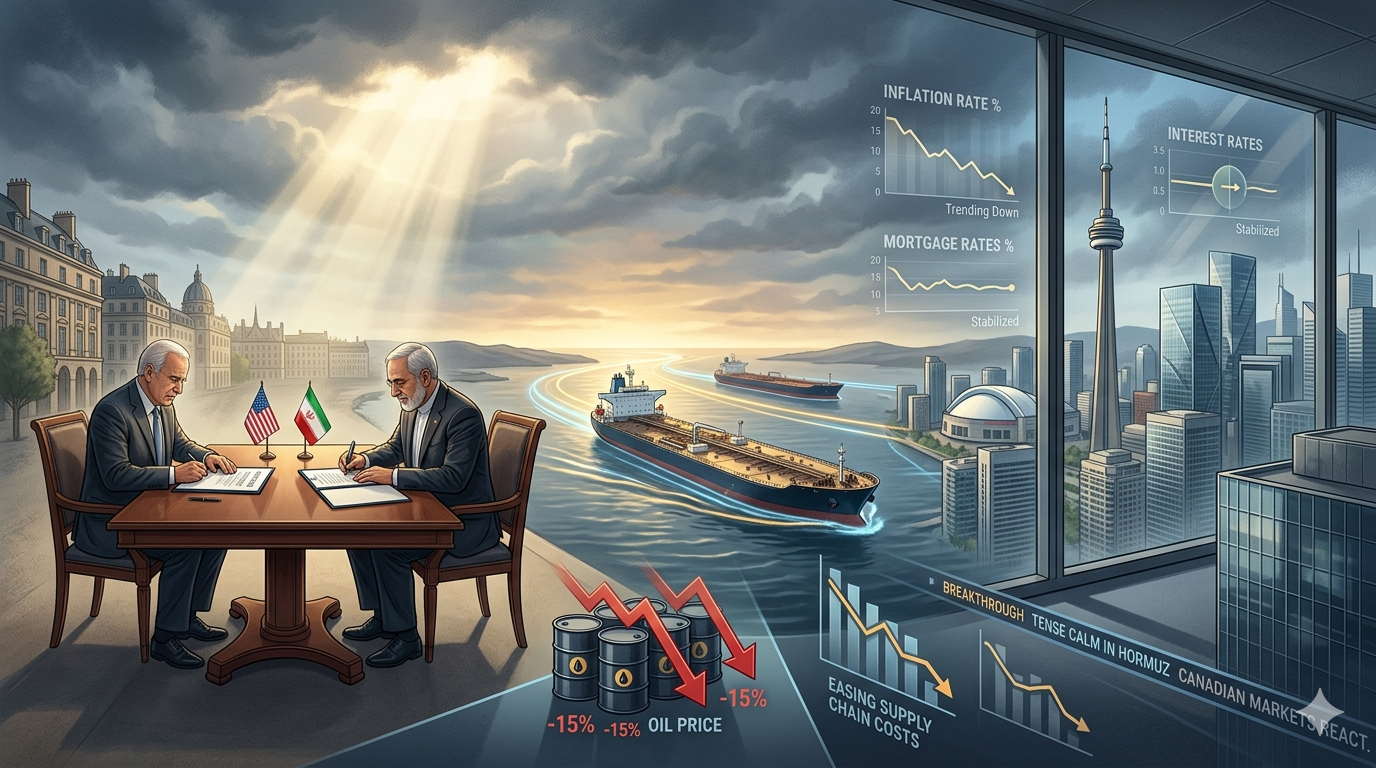
The biggest global story right now is the tentative peace agreement between the United States and Iran.
After months of conflict, multiple countries have confirmed that both sides have agreed to a framework aimed at ending hostilities and reopening the Strait of Hormuz, with a formal signing expected later this week.
At first glance, this might feel like a distant geopolitical headline. But for Canadians watching mortgage rates and inflation, it actually matters a lot.
It all starts with oil
Following the announcement, oil prices dropped roughly 5% as markets began removing the “geopolitical risk premium” that had been built into energy prices.
That shift is important because oil has been one of the key drivers of inflation risk.
When oil prices rise, the impact doesn’t stay in one place. It spreads through the economy:
Transportation costs increase
Goods become more expensive to move and produce
Businesses pass those costs to consumers
Overall inflation rises
And when inflation rises, central banks are forced into a tighter position.
They either keep interest rates higher for longer, or increase rates further to bring inflation back under control.
For everyday Canadians, that shows up as higher borrowing costs, more expensive mortgages, and tighter monthly budgets.
The potential shift: easing inflation pressure
The positive angle here is that lower oil prices remove some of that inflation pressure.
As inflation concerns ease, bond investors typically become more comfortable accepting lower yields.
We’ve already seen the Canadian 5-year government bond briefly dip below 3% before bouncing back as markets digest the news and reassess whether the agreement will actually hold.
That matters because fixed mortgage rates are heavily influenced by the 5-year Government of Canada bond yield.
If bond yields trend lower over time, fixed mortgage rates tend to follow.
What the Bank of Canada is watching
In its most recent communications, the Bank of Canada highlighted two major risks:
Trade and tariff uncertainty
Oil-driven inflation
We still don’t have much clarity on tariffs.
But if this agreement is formally signed and holds, one of the major inflation risks facing the global economy may begin to fade.
That would be supportive for borrowers, supportive for fixed mortgage rates, and generally positive for investors who benefit from lower financing costs.
Not out of the woods yet
That said, markets are pricing in optimism right now but optimism is not the same as certainty.
The key moment to watch is the expected signing later this week, and more importantly, whether both sides actually follow through in the weeks that follow.
Until then, volatility is still very much on the table.
