
MMM: Fixed vs. Variable Just Got Complicated
Mortgage rates have been unusually volatile lately.
Even after the Bank of Canada held its policy rate, there still seems to be a lot of uncertainty about where mortgage rates are headed next.
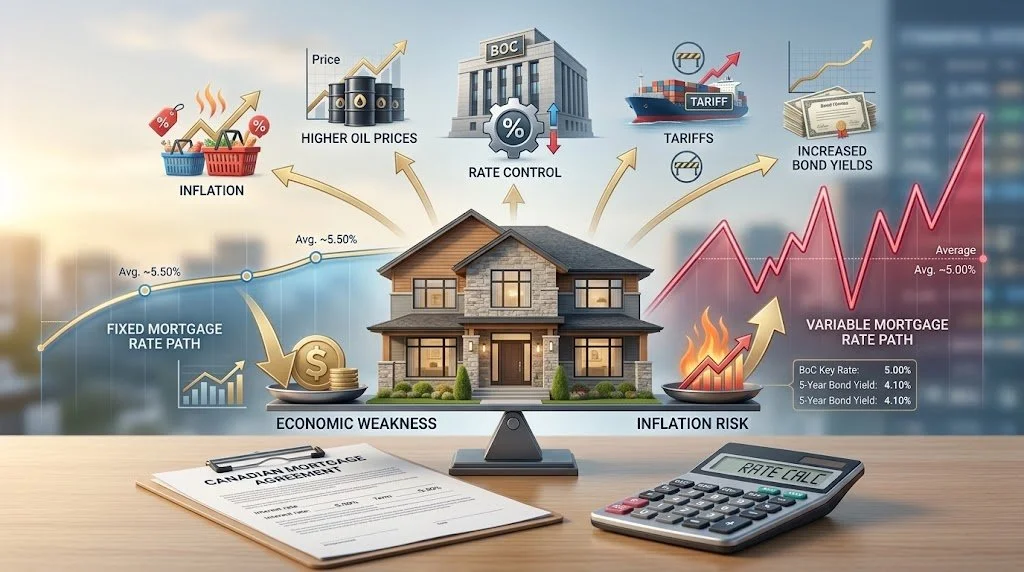
There are several competing forces affecting the Canadian economy right now, and they’re making the fixed-versus-variable mortgage decision more complicated than usual.
Two Major Risks Are Driving the Outlook
There are two key factors I’ve been watching closely:
Oil-driven inflation
The trade war
The trade war is now becoming a real factor for the Canadian economy. New U.S. tariffs and Canadian counter-tariffs are adding pressure to an economy that was already showing signs of weakness.
Canada also reported a loss of 42,000 jobs in August, while the Services PMI fell to 46.8, signalling contraction.
Normally, you might expect this combination to point toward lower interest rates:
Weak economy → Bank of Canada cuts rates → Variable mortgage rates fall
But there’s a problem.
Inflation remains around 3%, oil prices are elevated, and tariffs could create additional inflationary pressure.
That leaves the Bank of Canada balancing two competing risks.
If the Bank of Canada cuts rates:
It could provide relief to the economy, but it could also create more inflationary pressure.
If the Bank keeps rates higher:
It could help control inflation, but it puts additional pressure on consumers and businesses.
And that uncertainty is showing up in mortgage rates.
Variable Mortgage Rates Are Getting More Interesting
One of the more interesting things I'm seeing right now is the growing gap between fixed and variable mortgage rates.
Across many lenders, the spread between fixed and variable rates has widened to 0.50% or more.
That’s significant.
Remember, variable mortgage rates are generally based on:
Prime – Lender Discount = Variable Mortgage Rate
This means lenders don't necessarily need the Bank of Canada to cut rates before variable mortgage pricing becomes more competitive.
If a lender wants to attract more variable-rate borrowers, they can offer a larger discount from prime.
And that's exactly the kind of pricing I'm seeing in the market.
In some cases, the difference has become large enough that borrowers can qualify for a variable mortgage when they may not qualify for the comparable fixed mortgage.
That's something worth paying attention to.
Why Fixed Mortgage Rates Aren't Falling as Quickly
If the economy is weakening, you might expect fixed mortgage rates to fall as well.
But fixed mortgage rates don't directly follow the Bank of Canada's overnight rate.
They're heavily influenced by the bond market, and bond investors are still concerned about inflation.
Oil prices and tariffs add to those inflation concerns, which can push bond yields higher and keep fixed mortgage rates elevated.
So we're seeing two different forces at work:
Weak economy → Greater possibility of future Bank of Canada cuts → Positive for variable rates
Oil + tariffs → Inflation concerns → Higher bond yields → Pressure on fixed rates
That's why the mortgage market feels so uncertain right now.
So, Should You Choose Fixed or Variable?
There isn't one answer that works for everyone.
If you don't want to worry about your mortgage payment changing, a fixed mortgage may be worth the premium.
You're essentially paying for certainty.
You know what your payment will be, which can make budgeting much easier.
But if you have enough financial flexibility to handle some rate fluctuations, variable rates are becoming much more compelling.
In some cases, borrowers are starting 0.50% or more below fixed rates before the Bank of Canada even makes another cut.
That doesn't mean variable is automatically the better choice.
It means the potential reward may be more attractive for borrowers who are comfortable with the risk.
The Bottom Line
The interesting thing about variable mortgages right now isn't that the economic outlook is clear.
It's the opposite.
There are strong arguments pointing in both directions.
A weaker economy could eventually lead to lower rates, while oil prices, tariffs and inflation could keep rates higher for longer.
That's why choosing between fixed and variable shouldn't simply come down to which rate is lower today.
You also need to consider:
How long you expect to keep the mortgage
Your financial flexibility
Your tolerance for payment changes
Your qualification
Your overall financial goals
Variable isn't attractive because the outlook is clear.
It's attractive precisely because it isn't.
Thinking about renewing, refinancing, or getting a new mortgage? The right mortgage strategy depends on your individual situation, not just today's rate.
