
MMM : Do you actually know if you’re profitable?
Many business owners don't find out how their business actually performed until months after the year is over.
The bookkeeping gets cleaned up, financial statements are prepared, and eventually you get the answer:
“We made $140,000 last year.”
Or worse:
“Wait… we only made $14,000?”
By then, there isn't much you can do about it. The expenses have already been spent, pricing decisions have already been made, and any tax planning is largely looking backward.
That's exactly why monthly budgeting and budget-to-actual analysis can be so valuable.
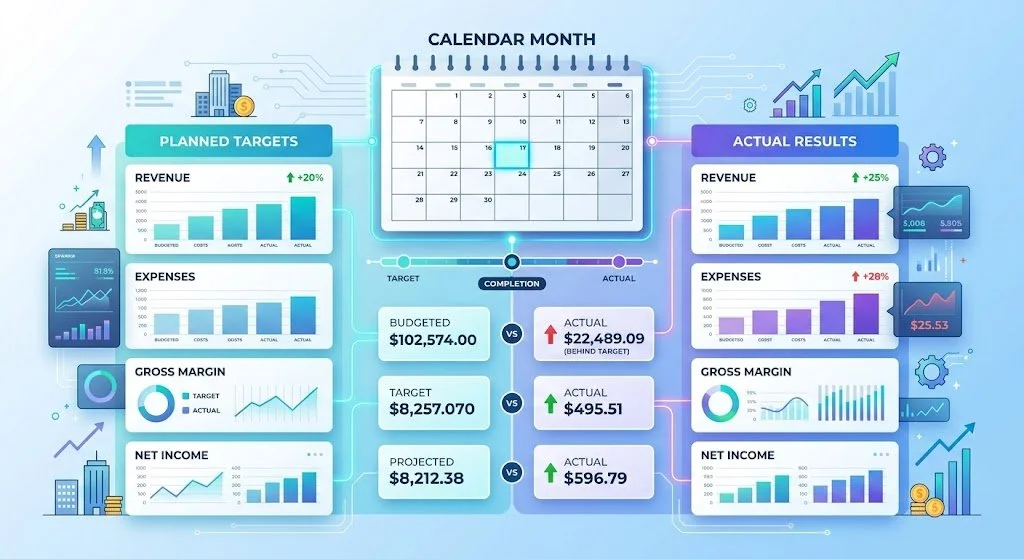
What Is Budget-to-Actual Analysis?
Budget-to-actual (BTA) analysis is simply comparing what you planned or expected to what actually happened.
Before the month begins, you establish targets for the numbers that matter most to your business.
Then, once the month is over, you compare those targets to your actual results.
For example, if your annual revenue goal is $600,000, your basic monthly target might be $50,000.
Personally, I like to pretend there are only 10 months in a year, so I might set the monthly target closer to $60,000 to create some breathing room.
The important part isn't the exact number.
It's establishing what “good” looks like before the month starts.
Why We Started Doing Monthly Budgeting
Two years ago, we started doing monthly budgeting and budget-to-actual analysis in our own business.
Before that, I was very reactionary. I would often deal with financial issues after the year was already over.
At first, monthly budgeting felt like another task to add to the list.
But it quickly became useful.
It helped us see when revenue was falling behind and gave us an opportunity to address costs before they got out of control.
Instead of waiting until year-end to ask, “What happened?”, we could ask that question while there was still time to do something about it.
A Real-World Example
Recently, a client told me that they estimated not having monthly budget-to-actual reporting was costing them around $60,000 in net income at one location.
Why?
Their labour costs were running higher as a percentage of revenue than they would have allowed if they had known about the problem earlier.
Without timely information, they didn't have the opportunity to make the necessary adjustments soon enough.
This is one of the biggest advantages of monthly BTA analysis:
It gives you information while you can still act on it.
Start With the Numbers That Matter
You don't need a complicated financial model with dozens of spreadsheets.
Start by deciding what you're actually trying to manage.
Depending on your business, that could include:
Revenue
Net income
Gross margin
Labour costs
Marketing expenses
Customer acquisition cost
Sales activity
Operating expenses
Then establish a target for each one.
For example, you might decide that:
Marketing should stay below 10% of revenue
Labour should stay below 30%
Gross margin should remain above 60%
The right numbers will be different for every business.
What matters is that you decide what your targets are before you see the results.
Don't Just Look at the Difference — Ask Why
Let's say your monthly revenue target is $60,000, but you finish the month at $56,000.
The $4,000 difference is important.
But the more important question is:
Why?
Did a deal not close?
Did you generate fewer leads?
Did your marketing spend change?
Did your close rate drop?
Were there unexpected delays?
The goal isn't simply to identify that you're behind.
The goal is to understand what caused the difference so you can make a better decision next month.
That's where bookkeeping starts moving from record keeping to decision making.
The Most Important Question: “So What?”
After reviewing your numbers, there is one question that matters more than anything else:
What are we going to change because of this information?
Maybe you need to adjust your pricing.
Maybe your marketing strategy needs to change.
Maybe you need to adjust staffing.
Maybe certain expenses need to be reduced.
Maybe your sales team needs to increase activity.
The numbers themselves aren't the solution.
The decisions you make because of the numbers are.
Don't Wait Until Year-End to Find Problems
Imagine you're behind your annual revenue goal in April.
You still have eight months to make adjustments.
You can change your sales strategy, increase marketing efforts, review pricing, control expenses, or make other changes to get back on track.
But if you discover the problem the following February, you've already lost the opportunity to respond in real time.
That's why monthly financial reporting can be so powerful.
It turns your financial information into something you can actually use to run the business.
You Don't Need a Complicated System
Budget-to-actual analysis doesn't have to mean building a 40-tab Excel model.
Start small.
Choose a few numbers that genuinely matter to your business.
Set the targets.
Compare the targets to reality.
Understand the differences.
And most importantly, ask:
“What are we going to do differently because of this information?”
That's where the real value is.
Monthly budgeting isn't just about knowing what happened.
It's about giving yourself enough information, early enough, to do something about it.
