
If you’re a business owner with money sitting in your corporation, you may be wondering how to put those funds to work, especially if you’re looking to invest in real estate.
Let’s talk about one of my favourite topics: the Holdco-Opco-Propco structure.
The Challenge: Buying Real Estate Through Your Business
Many business owners pay themselves somewhere between $50,000 and $150,000 a year. Depending on your lifestyle and personal expenses, this may be enough to live comfortably while leaving most of your business profits inside your corporation.
The challenge? Buying real estate often requires a substantial down payment, sometimes $100,000 or more.
If most of your money is tied up in your operating company, how can you use those funds to invest in real estate without triggering a large personal tax bill by withdrawing the money?
One option worth exploring is the Holdco-Opco-Propco structure.
How the Holdco-Opco-Propco Structure Works
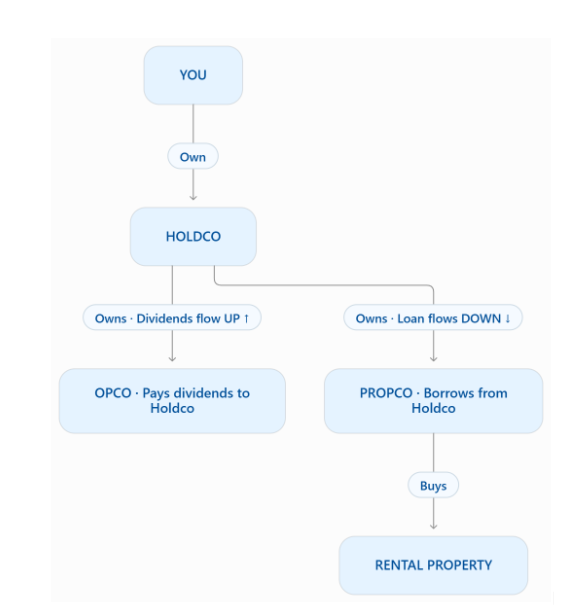
The concept is relatively straightforward. Each corporation has a specific role:
1. Opco (Operating Company)
This is the company that runs your business and generates revenue.
2. Holdco (Holding Company)
Your holding company owns your operating company. Depending on the corporate structure and applicable tax rules, your operating company may pay dividends up to the holding company.
3. Propco (Property Company)
Your holding company can then provide funds to a separate corporation set up to own real estate. This funding may be structured as a loan or an equity contribution, depending on your circumstances and the advice of your professional advisors.
The property company uses those funds toward purchasing real estate.
In simple terms, business profits can potentially move from Opco to Holdco and then to Propco, allowing you to invest corporate funds in real estate without first withdrawing all that money personally.
Why Consider This Structure?
When properly structured, a Holdco-Opco-Propco arrangement may offer several advantages.
Keep investments separate from day-to-day business operations.
Separating your real estate investments from your operating business can help reduce the exposure of those assets to certain business liabilities, provided the structure is implemented and maintained properly.
Put retained corporate earnings to work.
Instead of withdrawing funds personally and potentially paying personal tax on them, you may be able to use corporate funds to help finance a real estate investment.
Diversify your business wealth.
Moving funds into a separate property-owning corporation can help you build assets outside your main operating business.
Of course, the right structure depends on your business, your investment goals and your overall tax situation.
What About the Downsides?
The biggest downside is cost.
Maintaining multiple corporations means additional accounting, legal and administrative expenses. Before setting up a holding company and a separate property company, you need to determine whether the potential benefits justify those costs.
You also need to consider the tax implications of rental income. Depending on the circumstances, rental income earned by a corporation can affect its access to the small business deduction. This is an important consideration whether or not you use a holding company structure.
The structure isn't automatically the right choice for every business owner. It needs to make sense for your numbers and your long-term plans.
Is a Holdco-Opco-Propco Structure Right for You?
If you have retained earnings sitting in your corporation and want to start investing in real estate, this structure may be worth exploring.
The key is to understand how the money will move between corporations, how the transactions should be documented, and what the tax and legal implications are before making a move.
Want to explore your options?
Book a financing and mortgage strategy call with Mayu to discuss your goals and determine what approach may make sense for your situation.
This article is for general informational purposes only and is not tax, legal or investment advice. Consult your accountant and legal advisor to determine the appropriate structure for your circumstances.
